How to Cook a Steak Dinner for Two at Home Without Overcooking It

You spent real money on two good steaks. Now they sit in the fridge, and you are scared to ruin them. I know that feeling. My first steak came out gray, tough, and chewy, and it cost more than the wine I served with it.
This guide shows you how to make a steak dinner for two at home that tastes like a steakhouse meal. You get a deep brown crust, a juicy pink middle, and a garlic herb butter that melts right in the pan. Green beans cook in the same skillet, so you wash fewer dishes.
The method works because it takes the guessing out. A thick steak gives you time to react. A dry surface browns fast. A hot pan builds the crust. And a thermometer tells you the truth, so you never cut into the meat to check.
Plan on 1 hour 15 minutes from fridge to table. Most of that is waiting on the counter. About 30 minutes is hands on work, and the pan time is short. If you can turn on a stove and read a number on a thermometer, you can do this. Grab your steaks and let’s start.
- Buy two steaks that are 1.5 inches thick
- Warm the steaks on the counter for 45 minutes
- Pat the steaks dry
- Season with salt and pepper
- Mash the garlic herb butter
- Heat the skillet for 5 minutes
- Lay the steaks in the pan
- Sear for 3 minutes, then flip
- Baste with butter and thyme
- Check the temperature
- Rest for 8 minutes
- Cook the green beans
- Slice and plate
1. Buy two steaks that are at least 1.5 inches thick

Thin steaks cook through before the outside browns, which is how most beginners end up with gray meat. Pick ribeye or New York strip, about 12 ounces each. Check four things at the meat counter.
- Thickness of at least 1.5 inches
- Bright red color with no gray edges
- White flecks of fat running through the meat
- Two steaks of the same size, so they cook at the same speed
Packaged steaks look thin? Ask the butcher to cut two fresh ones. Sirloin works on a tighter budget, though it is leaner and less forgiving.
2. Take the steaks out of the fridge 45 minutes before cooking

45 minutes on the counter lets the chill leave the meat. A cold steak cooks unevenly, with a well done ring on the outside and a cold, raw center. This is safe, since whole steaks can sit out for under 1 hour. Put them on a plate, uncovered, and leave them alone.
3. Pat both sides of each steak completely dry

If the surface looks shiny or wet, the steak will steam in the pan instead of browning. Steam keeps the heat low, so you get a pale, gray crust. Press 2 to 3 paper towels firmly onto the top, bottom, and sides of each steak. Swap in fresh towels once the first ones soak through. No paper towels? A clean kitchen towel works, but wash it right after. Pat again if you still see shine.
4. Season every side with coarse salt and black pepper

Salt right before cooking, not an hour ahead. The steaks are warm and dry now, so the salt stays on the surface and helps build a crust. Hold your pinched fingers about 8 inches above the meat, because that height spreads the grains evenly. Use 1 teaspoon of kosher salt and ½ teaspoon of pepper per steak, and season the thin edges too. Only have fine table salt? Use half the amount, since it packs tighter.
5. Mash the garlic herb butter and set it aside

A fork does all the work here. Press these together in a small bowl for about 1 minute, until the butter looks smooth and speckled with green.
- 4 tablespoons softened butter
- 2 cloves minced garlic
- 1 tablespoon chopped parsley
Mashing pushes the garlic flavor into every bite. If the butter is still hard, cut it into small cubes and wait 10 minutes. Leave the bowl on the counter, not in the fridge.
6. Heat a heavy skillet over medium high heat for 5 minutes
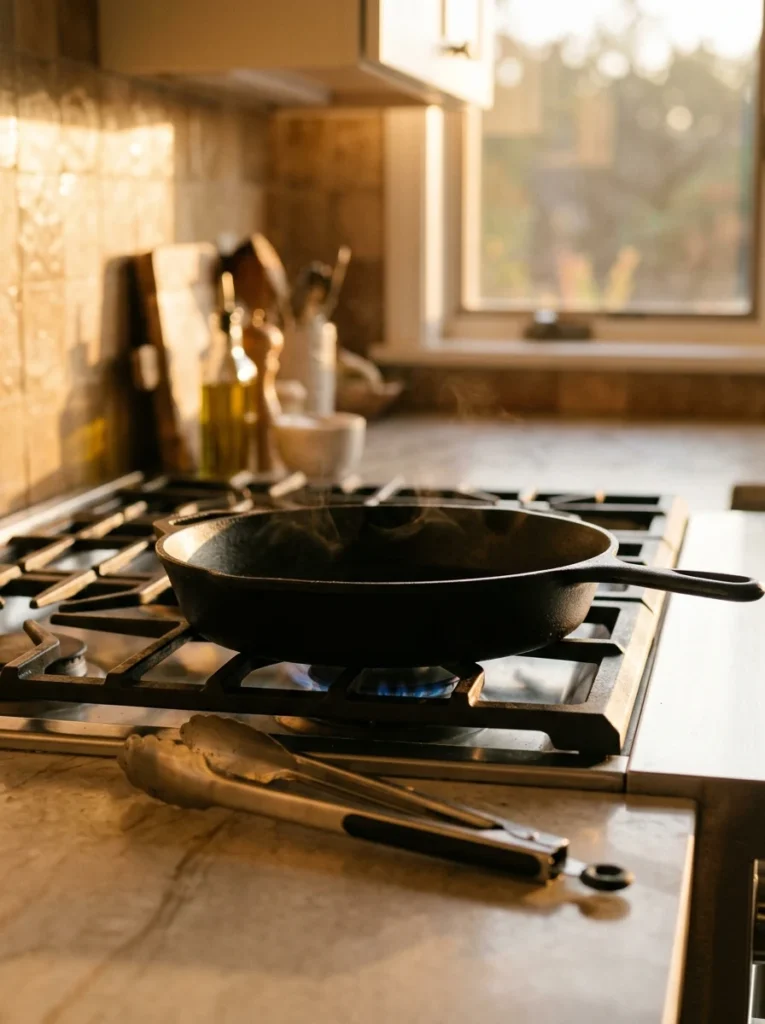
Open a window and turn on the vent fan before the pan gets hot, because searing makes smoke. Set the empty skillet on the burner with no oil yet, and wait the full 5 minutes. A short wait gives you a weak crust. Cold meat drops the pan’s heat the moment it lands, and only a fully heated heavy pan can recover fast enough to keep browning.
7. Lay the steaks in the pan, pointing away from you

8. Leave the steaks alone for 3 minutes, then flip
The oil goes in first. Pour 1 tablespoon into the hot skillet and wait for it to shimmer, which takes about 10 seconds. Lay each steak down away from your body, so any splash heads the other way. Leave 1 inch between them. You should hear a loud sizzle right away. A weak sizzle means the pan needed more time, so turn the heat up a notch and add 1 minute to the sear.

Three minutes feels like a long time to watch a steak do nothing. That stillness is what builds the crust, because the browning only happens where the meat stays in full contact with the metal. Set a timer and keep your hands off. When it rings, slide the tongs under one edge and check the underside. It should be deep brown, almost mahogany. Flip with tongs, never a fork. A fork pokes holes, and the juices run out through them.
9. Baste the steaks with butter, garlic, and thyme
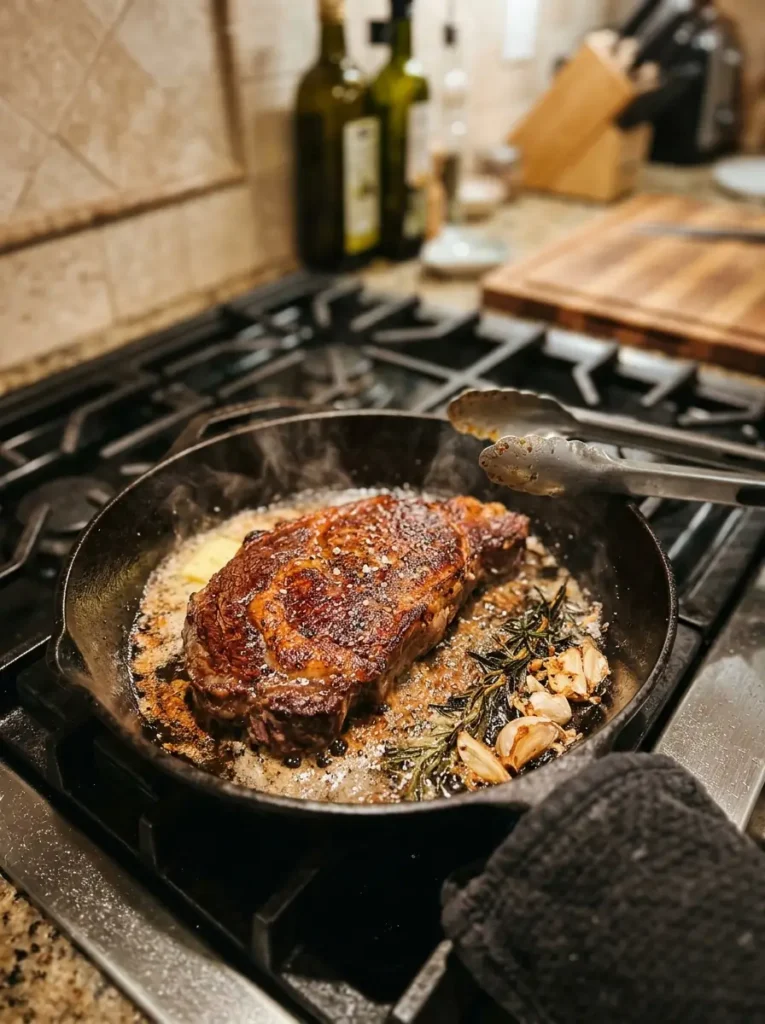
Garlic burns faster than steak cooks, so lower the heat before the butter goes in. Butter spooned over the top cooks the side facing up and adds the flavor you pay for at a steakhouse. Work through these five moves in order.
- Turn the burner down to medium
- Add the garlic herb butter and 3 sprigs of thyme
- Tilt the pan toward you so the butter pools
- Spoon the foaming butter over the steaks
- Keep spooning for about 2 minutes
If the butter turns dark brown or smells bitter, pull the pan off the heat for 15 seconds.
10. Check the temperature with a meat thermometer

Pressing the steak with a finger tells a beginner almost nothing, and cutting it open lets the juices out. A thermometer gives you a number you can trust. Start checking after the 2 minutes of basting, then check again every 30 seconds until you hit your pull temperature. For medium rare, pull the steaks at 125°F. They will climb to about 130°F to 135°F while they rest.
11. Rest the steaks on a plate for 8 minutes

If you cut the steak now, the juices pour onto the board and the meat dries out. Move both steaks to a clean plate right away, because the hot pan keeps cooking anything left in it. Tent them loosely with foil, or leave them open. Set a timer for 8 minutes.
12. Toss green beans in the same pan while the steaks rest
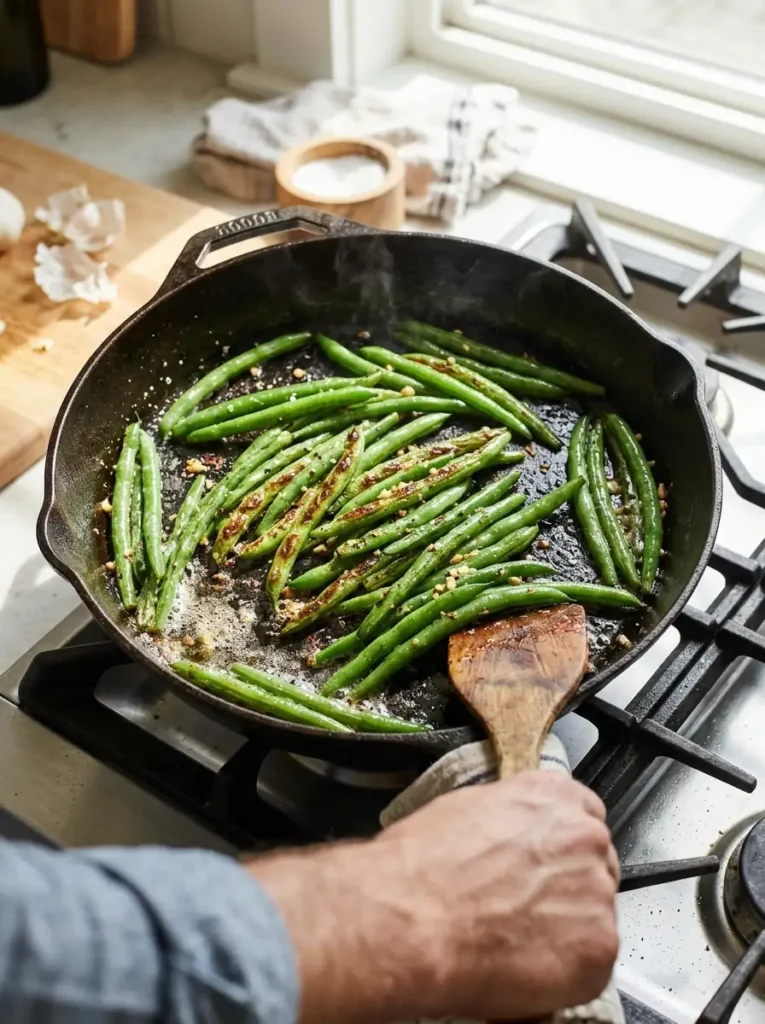
The pan still holds browned bits and butter, which is free flavor for the beans. Raise the heat to medium high and add 8 ounces of trimmed green beans with a pinch of salt. Toss them with tongs for 4 to 5 minutes, until they turn bright green and show a few brown spots. Watch your hand. The skillet handle is as hot as the pan, so wrap it in a dry towel before you touch it.
13. Slice against the grain and plate the steak dinner for two
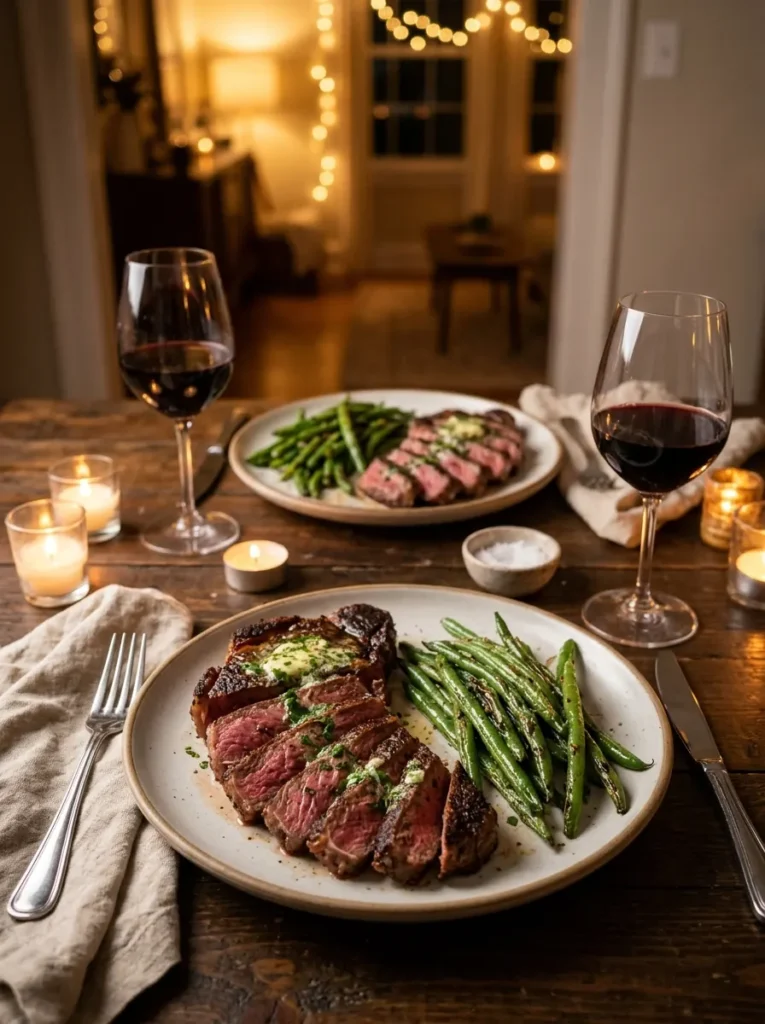
Look closely at the meat and you will see thin lines running in one direction. Those are the muscle fibers, and the knife should cut across them, not along them. Cutting across shortens each fiber, so every bite chews softer. Slice into strips about ¼ inch thick. Fan the strips on warm plates beside the green beans, then pour the juices from the resting plate over the top.
Serve right away. A steak cools fast, and the crust is at its best in the first few minutes.
| 😟 If This Happens | ✅ Try This |
|---|---|
| 🩶 The steak is gray with no crust | The pan was not hot enough, the steak was wet, or the pan was crowded. Heat the skillet the full 5 minutes, pat the steaks dry, and leave 1 inch between them. |
| 💨 The kitchen fills with smoke | Some smoke is normal. Turn on the vent fan, open a window, and use avocado or canola oil, which handles high heat better than olive oil. Drop to medium before adding butter. |
| 🔥 The steak is overcooked | You pulled it too late. Take it off the heat 5°F to 10°F before your target, since it keeps rising while it rests. Next time, check the temperature earlier. |
| 😬 The steak is tough and chewy | Check three things. Did you rest it a full 8 minutes? Did you slice across the grain? Did it go past your target temperature? Fix whichever one you missed. |
| 🧊 The outside is brown but the center is cold | The steak was too cold when it hit the pan. Give it the full 45 minutes on the counter next time. For this batch, lower the heat to medium low and baste for 2 more minutes. |
| 🧄 The garlic butter tastes bitter | The heat was too high and the garlic burned. Turn the burner down to medium before the butter goes in, and lift the pan off the heat for 15 seconds if the butter darkens fast. |
Conclusion
You did it. Two thick steaks are now on warm plates, with a brown crust, a pink center, and garlic butter running over the top.
The hard part is behind you, and a steak dinner for two at home is now something you can repeat any weekend. Next time, try a different cut, or swap the green beans for roasted potatoes.
Save this guide to your Pinterest dinner board so it is ready for your next celebration.